Insurance coverage disputes can involve unusual facts, but the facts in Parsons v. Crum & Forster Specialty Insurance Company are particularly striking. The case arose from the sale of a product marketed as grain alcohol and intended for ethanol-extraction and related uses. In reality, it contained lethal concentrations of methanol, a toxic industrial alcohol capable of causing blindness, organ failure, and death.
The resulting injuries generated multiple lawsuits across the country and ultimately led to a dispute over whether the claims belonged under a commercial general liability (“CGL”) policy’s products-completed operations coverage or a separate pollution liability coverage form. The Indiana Court of Appeals recently held that the claims fell within the policy’s products-completed operations coverage rather than its pollution liability coverage. The decision highlights the importance of correctly identifying the applicable coverage part at the outset when a policy contains overlapping or potentially competing coverage grants.
Facts
The facts read more like a products liability case than a traditional environmental contamination claim. In 2016, the insured purchased approximately 6,500 gallons of denatured alcohol from a supplier that had obtained the product from a cargo-barge cleaning operation. The material consisted of remnants from multiple industrial alcohol shipments that had been combined into a single mixture. Despite shipping documents identifying the product as a blend of industrial alcohols and additives, the insured distilled and bottled it without testing its contents.
The company sold the product as “Ethanol Extraction.” The bottles were labeled as containing 190-proof, non-denatured grain alcohol consisting of 95% ethanol and 5% purified water. In reality, the product contained substantial amounts of methanol, a toxic substance that should never be consumed. The product’s labeling, reproduced in the court’s opinion, underscores why the case ultimately looked more like a products liability dispute than a traditional pollution claim.
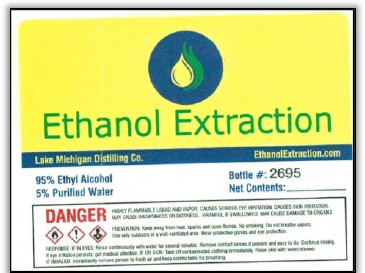
Figure 1: Ethanol Extraction label reproduced in the court’s opinion. The court concluded that the resulting claims fell within the products-completed operations coverage rather than the policy’s pollution liability coverage.
The product was marketed to individuals involved in cannabis extraction and similar applications. One claim arose after a Nevada woman used the product to make marijuana-infused brownies and died after consuming them. Other consumers allegedly purchased the product believing they were buying inexpensive grain alcohol suitable for consumption. One claimant reportedly drank nearly a gallon over several months and allegedly suffered partial vision loss.
The product was linked to multiple injuries and deaths, including the death of Massachusetts resident Timothy Parsons. After Parsons died from acute methanol intoxication, testing revealed that the product contained approximately 42.7% methanol. Additional investigations connected the product to other serious injuries and fatalities.
The Coverage Dispute
The insured’s policy contained both CGL coverage and a separate Third-Party Pollution Liability (“TPPL”) coverage form. Notably, the TPPL’s coverage grant mirrored the language of the CGL Total Pollution exclusion. The insurer determined that the presence of methanol constituted a covered pollution condition and handled the claims under the TPPL form rather than under the policy’s products-completed operations coverage. Defense costs and settlements eventually exhausted the TPPL limits.
The dispute that followed was straightforward: did the claims belong under the TPPL coverage form or under the products-completed operations coverage? The insurer argued that methanol was a pollutant under the policy’s broad definition. The claimants argued that the injuries arose from the manufacture and sale of a defective product. The Indiana Court of Appeals ultimately agreed with the claimants.
The Decision
Relying on a line of Indiana Supreme Court decisions, the court held that insurers seeking to classify a substance as a pollutant must do so with sufficient specificity. Because the policy did not specifically identify methanol as a pollutant, the insurer could not rely on the policy’s pollution provisions to limit the claims to TPPL coverage.
The court also focused on how the injuries occurred. Methanol remained contained within the finished product and was not released into the environment. Rather, it was present in the product that the insured manufactured, marketed, and sold. Because the injuries allegedly resulted from the manufacture and sale of a defective product, the court concluded that the claims fell within the policy’s products-completed operations coverage.
Practical Lessons for Insurers
Parsons demonstrates that determining which coverage part applies may be just as important as determining whether coverage exists at all.
First, insurers seeking to classify substances as pollutants should consider whether policy language identifies those substances with sufficient precision. Broad references to “chemicals,” “contaminants,” or substances harmful to living things may not suffice in jurisdictions that follow Indiana’s approach.
Just as importantly, not every jurisdiction approaches pollution-related claims the same way. Courts in Indiana, New York, and California have often resisted efforts to apply pollution provisions outside the traditional environmental contamination setting. As such, the outcome of a pollution coverage dispute may depend as much on the governing jurisdiction as on whether the substance at issue qualifies as a pollutant under applicable law.
Second, carriers offering both CGL and environmental coverage should carefully evaluate coverage-part allocation at the outset of a claim. In Parsons, the policy contained a provision making the pollution coverage part exclusive when applicable. Once the pollution limits were exhausted, the initial coverage-part determination became outcome-determinative.
Third, courts may focus less on the inherent nature of a substance and more on how the injury occurred. A claim involving a toxic substance is not necessarily a pollution claim if it more naturally resembles a traditional products liability loss.
Broader Industry Implications
The significance of Parsons extends beyond methanol. Similar disputes can arise in cases involving contaminated food products, pharmaceuticals containing harmful ingredients, vaping products, cannabis-derived products, and consumer goods alleged to contain toxic substances.
As product contamination and toxic substance litigation continue to expand, insurers increasingly face arguments that such losses should be treated as pollution claims. Parsons suggests that at least some courts may resist that characterization where the claim more naturally resembles a traditional product defect case. The decision serves as a reminder that a toxic substance is not necessarily a pollutant, and a contamination claim is not necessarily a pollution loss.
Beyond pollution exclusions, this case underscores a broader coverage issue. Should a claim be allocated to a specialized coverage form or to traditional CGL coverage? That question increasingly appears in claims involving food products, pharmaceuticals, cannabis products, consumer goods, and other products alleged to contain harmful substances. And, in some jurisdictions, a claim can fall under both coverages.
Conclusion
As toxic-substance claims continue to expand, Parsons illustrates the growing importance of distinguishing between product liability and pollution liability at the outset of a coverage analysis.